| |
|
| |
 |
- MEMS
- Rapid Proto Typing
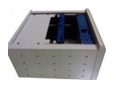
- Sheet Metal Fabrication
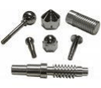
- Manual and CNC Machining
- Welding
Rapid Proto Typing
Prototyping technologies
Selective laser sintering (SLS)
Fused deposition modeling (FDM)
Stereolithography (SLA)
Laminated object manufacturing (LOM)
Electron beam melting (EBM)
3D printing (3DP) |
Base materials
Thermoplastics, metals powders
Thermoplastics, eutectic metals.
photopolymer
Paper
Titanium alloys
Various materials |
Shape modifying with material retention processes
These processes modify the shape of the object being formed, without removing any material.
- Casting
- Sand casting
- Shell casting
- Investment casting (called Lost wax casting in art)
- Die casting
- Spin casting
- Plastic deforming
- Forging
- Rolling
- Extrusion
- Spinning
- Stamping
- Powder forming
- Sintering
- Sheet metal forming
- Bending: A calculated deformation of the metal from its original shape.
- Drawing
- Pressing
- Spinning
- Flow turning
Common plastics and their uses
| Polyethylene (PE) |
| Wide range of inexpensive uses including supermarket bags, plastic bottles. |
| Polypropylene (PP) |
| Food containers, appliances, car fenders (bumpers). |
| Polystyrene (PS) |
| Packaging foam, food containers, disposable cups, plates, cutlery, CD and cassette boxes. |
| High impact polystyrene (HIPS) |
| Fridge liners, food packaging, vending cups. |
| Acrylonitrile butadiene styrene (ABS) |
| Electronic equipment cases (e.g., computer monitors, printers, keyboards). |
| Poly(ethylene terephthalate) (PET) |
| Carbonated drinks bottles, jars, plastic film, microwavable packaging. |
| Polyester (PES) |
| Fibers, textiles. |
| Polyamides (PA) (Nylons) |
| Fibers, toothbrush bristles, fishing line, under-the-hood car engine moldings. |
| Poly(vinyl chloride) (PVC) |
| Plumbing pipes and guttering, shower curtains, window frames, flooring, clothing. |
| Polyurethanes (PU) |
| Cushioning foams, thermal insulation foams, surface coatings, printing rollers. (Currently 6th or 7th most commonly used plastic material, for instance the most commonly used plastic found in cars). |
| Polycarbonate (PC) |
| Compact discs, eyeglasses, riot shields, security windows, traffic lights, lenses. |
| Polyvinylidene chloride (PVDC) (Saran) |
| Food packaging. |
| Bayblend (PC/ABS) |
| A blend of PC and ABS that creates a stronger plastic: Car Interior and exterior parts. |
Special-purpose plastics
Polymethyl methacrylate (PMMA) |
| Contact lenses, glazing (best known in this form by its various trade names around the world, e.g. "Perspex", "Oroglas", "Plexiglas"), fluorescent light diffusers, rear light covers for vehicles. |
| Polytetrafluoroethylene (PTFE) (trade name Teflon) |
| Heat-resistant, low-friction coatings, used in things like "non-stick" surfaces for frying pans, plumber's tape and water slides. |
| Polyetheretherketone (PEEK) (Polyketone) |
| Strong, chemical- and heat-resistant thermoplastic, biocompatibility allows for use in medical implant applications, aerospace moldings. One of the most expensive commercial polymers. |
| Polyetherimide (PEI) (Ultem) |
| A General Electric product, similar to PEEK. |
| Phenolics (PF) or (phenol formaldehydes) |
High modulus, relatively heat resistant, and excellent fire resistant polymer. Used for insulating parts in electrical fixtures, paper laminated products (e.g. "Formica"), thermally insulation foams. It is a thermosetting plastic, with the familiar trade name "Bakelite", that can be molded by heat and pressure when mixed with a filler-like wood flour or can be cast in its unfilled liquid form or cast as foam, e.g. "Oasis". Problems include the probability of moldings naturally being dark colors (red, green, brown), and as thermoset difficult to recycle. Urea-formaldehyde (UF), one of the aminoplasts and used as multi-colorable alternative to Phenolics. Used as a wood adhesive (for plywood, chipboard, hardboard) and electrical switch housings. Melamine formaldehyde (MF), one of the aminoplasts, and used a multi-colorable alternative to phenolics, for instance in moldings (e.g. break-resistance alternatives to ceramic cups, plates and bowls for children) and the decorated top surface layer of the paper laminates (e.g. "Formica"). |
| Polylactic acid |
| A biodegradable, thermoplastic, found converted into a variety of aliphatic polyesters derived from lactic acid which in turn can be made by fermentation of various agricultural products such as corn starch, once made from dairy products. |
| Plastarch Material |
| Biodegradable and heat resistant, thermoplastic composed of modified corn starch. |
|
|
|
| |
|
|